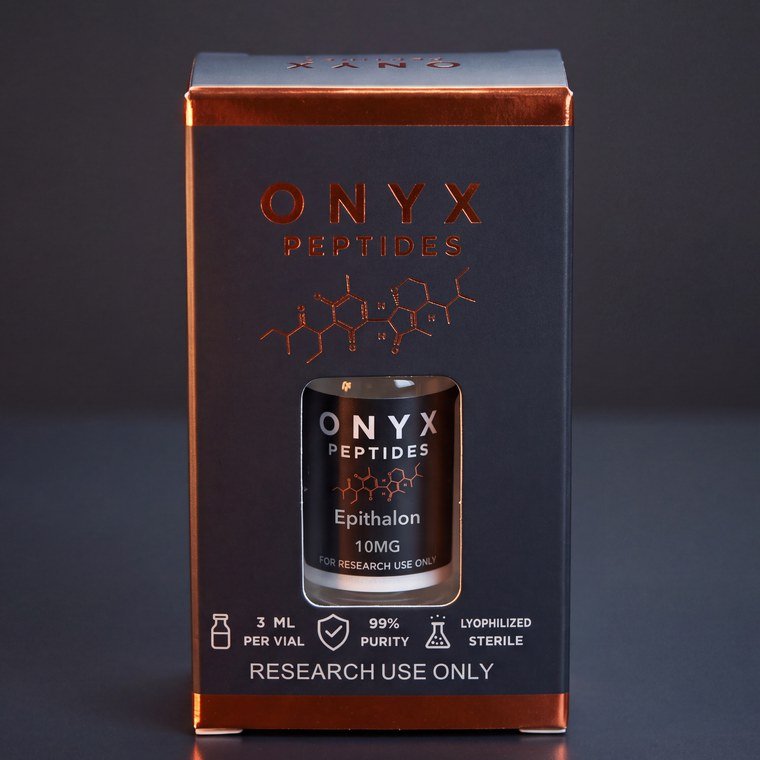
Epithalon 10mg
Epithalon (also known as Epitalon or Epithalone) is a synthetic tetrapeptide with the sequence Ala-Glu-Asp-Gly, based on the natural peptide epithalamin produced by the pineal gland. Developed by Professor Vladimir Khavinson at the Saint Petersburg Institute of Bioregulation and Gerontology, Epithalon is primarily studied for its effects on telomerase activity.
Telomerase is the enzyme responsible for maintaining telomere length — the protective caps on chromosome ends that shorten with each cell division and are strongly associated with cellular aging. Research has documented Epithalon ability to activate the catalytic subunit of telomerase (hTERT) in human somatic cells, potentially extending cellular replicative capacity.
Beyond telomerase activation, Epithalon research spans neuroendocrine regulation, circadian rhythm modulation through melatonin synthesis, and antioxidant enzyme expression. Studies have investigated its effects on pineal gland function, cortisol rhythm normalisation, and age-related changes in hormonal profiles. This multi-pathway activity profile has made it one of the most studied peptides in aging research.
| SKU | ONX-EPITA-10 |
|---|---|
| Purity | 99%+ |
| Molecular weight | 390.35 Da |
| Molecular formula | C14H22N4O9 |
| CAS number | 307297-39-8 |
| Amino-acid sequence | Ala-Glu-Asp-Gly |
| Amino-acid count | 4 |
| Appearance | White to off-white lyophilised powder |
| Solubility | Reconstitutes in bacteriostatic water |
| Storage | Store at 2–8 °C, protected from light |
| Shelf life | 36 months at 2–8 °C |
Research relevance
- Studied as a synthetic tetrapeptide in telomere-biology research
- Investigated for induction of telomerase activity in somatic-cell models
- Examined in pineal-gland and circadian-regulation contexts
Published references
Related research notes
References are provided for scientific background only. They describe preclinical and laboratory research and do not constitute medical, therapeutic, or efficacy claims. This product is sold strictly for research use.
What is Epithalon?
Epithalon (also known as Epitalon or Epithalone) is a synthetic tetrapeptide with the sequence Ala-Glu-Asp-Gly, based on the natural peptide epithalamin produced by the pineal gland. Developed by Professor Vladimir Khavinson at the Saint Petersburg Institute of Bioregulation and Gerontology, Epithalon is primarily studied for its effects on telomerase activity.
Where can a laboratory buy Epithalon in the EU?
Onyx Peptides supplies Epithalon for laboratory research across the European Union. We are operated by Vexio j. s. a. (IČO 54214530) in Slovakia and dispatch from within the EU, so there is no customs entry, no import duty and no border hold. Orders placed before 16:00 CET ship the same day, and shipping is free above €100.
How do I verify the batch of Epithalon I receive?
Each vial carries a batch number. Ask us for the Certificate of Analysis of the batch currently in stock — before you order, not after — and check that the batch number on the certificate matches the one printed on the vial. The analysis is performed by Janoshik Analytical, an independent laboratory in Prague, which will confirm a report it issued if you contact them with its identifier.
How is purity verified?
Every batch is independently tested by Janoshik Analytical using HPLC and Mass Spectrometry. A batch-specific Certificate of Analysis — also covering endotoxins and heavy metals — is available on request.
How fast is delivery?
We dispatch from within the EU, same day on orders placed before 16:00 CET. EU delivery typically takes 1–3 business days.
What payment methods do you accept?
We accept SEPA bank transfer (−2 %), cryptocurrency (−5 %), cash on delivery (+€1.50). Bank-transfer orders are dispatched as soon as the payment clears; SEPA instant transfers usually arrive within seconds.
How should this be stored?
Store at 2–8 °C, protected from light. Once reconstituted, keep refrigerated and use within 30 days.
What is the intended use?
All products are supplied strictly for in-vitro laboratory and research use only. They are not for human consumption, veterinary, or clinical use.